Local tool and Claude Code skill
apply
Helps me understand a short video: it measures cuts, colors and tempo, transcribes the speech, and only then lets Claude interpret what can’t be measured.
How it works
One video goes in, one folder comes out. apply measures first and lets Claude interpret second, and you decide before anything costs money.
- You Video file on your Mac
- apply on your Mac Show what the run would cost
- You Go ahead?
- apply on your Mac Pull frames and audio (offline)
- apply on your Mac Measure cuts, colors, tempo, speech, text (free)
- Claude Interpret only what can’t be measured (after your OK)
- apply on your Mac Check the answer: nothing invented counts as measured
- You Folder with analysis, plan, shot list, prompts
- You Or: Stop, nothing spent
What it looks like
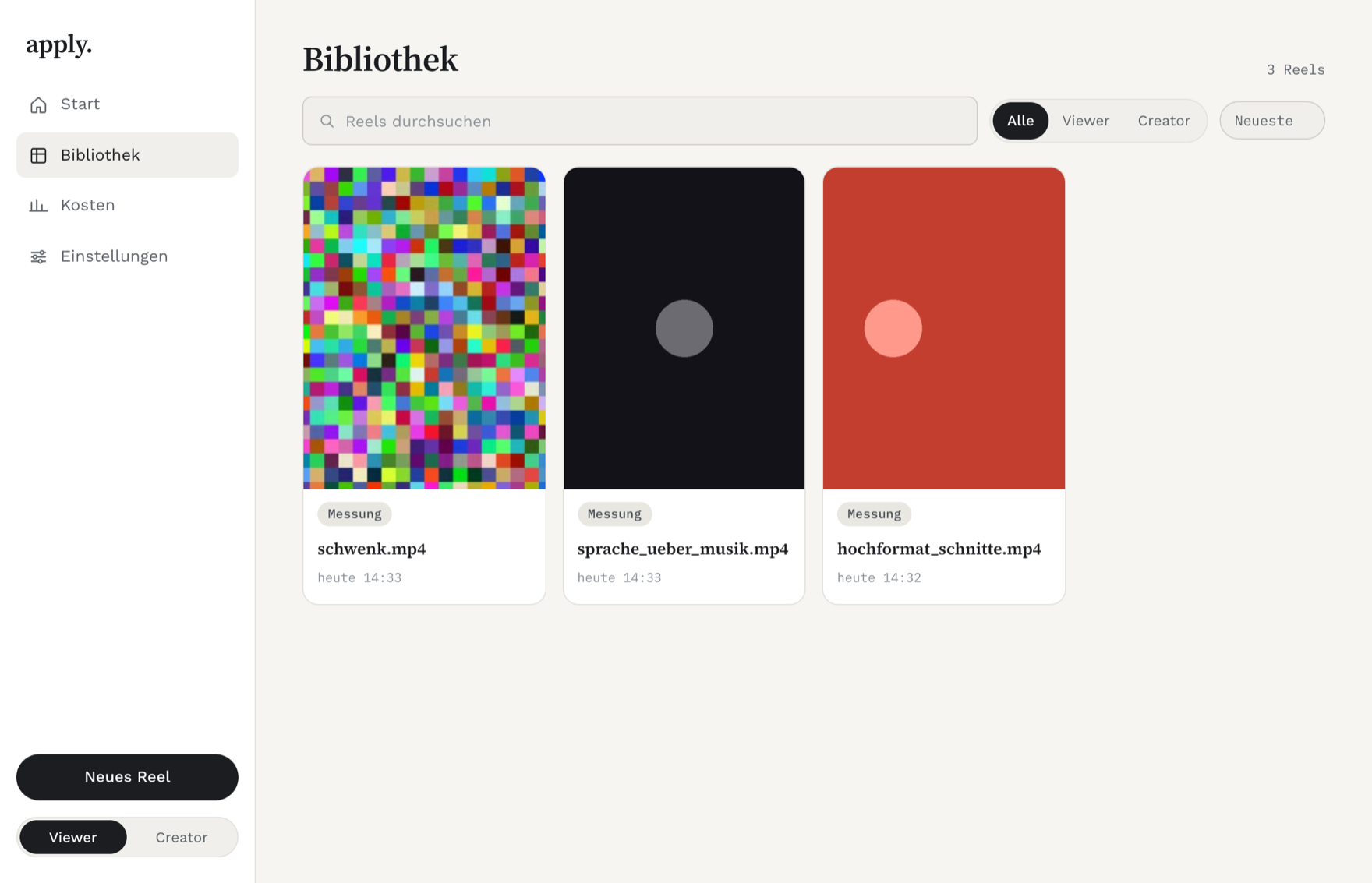
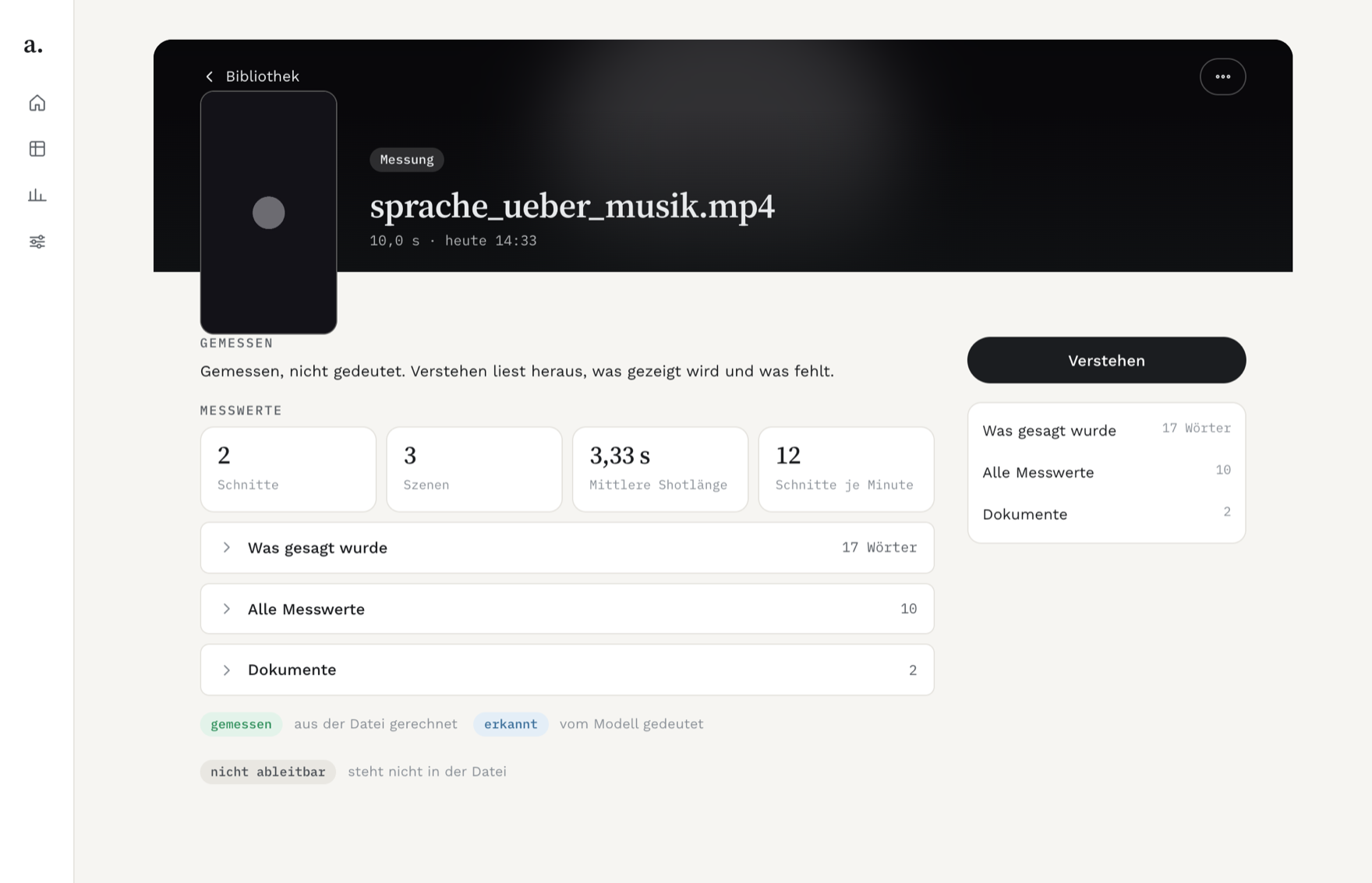
Shown with three synthetic test videos, not real footage. The app’s interface is in German.
The problem
In a short video, cuts, colors, tempo and words all work together, and a quick look doesn’t tell me why it works. Ask an AI directly, and I can’t tell what it actually saw from what it guessed.
What I built
- A measuring step that runs on my Mac: scene cuts, colors, tempo and a transcript.
- An interpretation step in which Claude covers only what can’t be measured. Every statement is tagged as “measured”, “recognized” or “can’t be determined”.
- A command-line tool, a native macOS app and the Claude Code skill /apply.
- It only reads video files already on my computer; it never downloads videos or imports them from a link.
Where Claude comes in
I built apply with Claude Code: the app layer was built task by task, each by a fresh subagent, with two review stages per task.
Inside the tool, apply calls the Claude API with structured output. I measured the tokens per frame with count_tokens and confirmed prompt caching in a real run. The default model is claude-sonnet-5; other providers can be plugged in as well.
With the /apply skill, the interpretation moves into Claude Code: apply measures, Claude interprets in the conversation, and apply checks the answer against the same schema.
Decisions
- The model can’t claim to have measured
“Measured” is reserved for apply’s own measurements. The schema only lets Claude answer with “recognized” or “can’t be determined”. Source: Answer schema of apply’s interpretation step
- Local files only
apply never imports from a URL. A test searches the code for downloader calls. Source: Acceptance test “no URL import anywhere” in the apply repository
- Interpretation inside Claude Code
Through the /apply skill, the interpretation runs in my Claude Code conversation instead of the API: no API key and no charge per video.
Where it stands
Built and in personal use: command line, macOS app and the /apply skill. It runs only on my Mac, the repository is private, there is no download, and so far no one but me uses it. I decided not to sell it. It stays a tool I use to understand short videos and learn from them.
What I learned
The most useful rule was a structural one. When the schema doesn’t allow the model to say “measured”, no prompt can talk it into it.